
What Makes Our Sand
Different
Quality in construction sand is invisible — until it fails. pH level, salt content, silt percentage, particle shape, gradation — these properties determine whether your structure holds for decades or develops problems within years. Every parameter of Stonage dam-dredged sand is tested, documented, and certified before it reaches your site.
6.8–7.2
Certified pH Range
0%
Salt Content
<3%
Max Silt Content
IS 383
Zone II Gradation
Quality Parameters
Six Properties That
Define Our Sand
Every batch of Stonage dam-dredged river sand is evaluated against these six critical quality parameters before dispatch. This is what separates construction-grade certified sand from ordinary supply.
01
6.8 – 7.2
Neutral pH
The most critical invisible quality marker in construction sand. A neutral pH means no acid to dissolve calcium compounds in concrete, and no alkali to attack cement hydration or accelerate steel corrosion. Stonage sand is tested per batch and certified within this range before every dispatch.
Tested Every Batch02
Negligible
Salt & Chloride Content
Sourced from inland dam reservoirs with zero tidal or sea influence, Stonage sand contains effectively no chlorides. High chloride sand corrodes steel reinforcement from inside the structure — a slow, invisible failure that can compromise an entire building over 10–15 years.
Zero Sea Influence03
< 3%
Silt & Clay Content
Decades of hydraulic settling in dam reservoirs naturally separates fine silt and clay from usable sand particles. High silt content coats sand grains, weakening the bond between cement paste and aggregate — directly reducing mortar and concrete strength.
Naturally Washed04
Rounded
Particle Shape
Natural river sand particles are rounded by water erosion over thousands of years. Rounded particles roll past each other in a mix, requiring less water to achieve workability. Angular manufactured sand particles interlock and create harsh, stiff mixes that demand more water and cement.
Water-Worn Natural Shape05
Zone II
Gradation — IS 383:2016
Stonage sand falls within Zone II of IS 383:2016 — the Indian Standard specification for fine aggregates used in concrete. Zone II gradation provides the ideal particle size distribution for both concrete and masonry mortar, minimising voids and cement usage while maximising compressive strength.
IS 383:2016 Compliant06
2.60–2.65
Specific Gravity
A specific gravity of 2.60–2.65 is consistent with clean, uncontaminated river sand. Lower values indicate high organic content or silt. Higher values indicate heavy minerals or crushed stone. Stonage sand consistently falls within the ideal range for structural concrete design.
Consistent & Predictable7.0
Neutral pH — Certified
Acid
Neutral
Alkaline
Why pH Matters
The Invisible Property
That Changes Everything
Alkaline Sand Attacks Cement Bonds
M-Sand typically has a pH of 8–9.5. At this alkalinity, the cement paste undergoes alkali-silica reaction over time — causing internal expansion, cracking, and loss of compressive strength. This is irreversible and invisible until damage is severe.
Acidic Sand Corrodes Steel Reinforcement
Sand with pH below 6.5 creates a micro-acidic environment around steel rebars. Over years, this strips the protective oxide layer from the steel, initiating corrosion that expands the rebar volume — cracking concrete from the inside out.
Neutral Sand Protects Everything
At pH 6.8–7.2, sand neither attacks cement paste nor corrodes steel. Stonage dam-dredged sand maintains this neutral range naturally — a result of years of buffering in freshwater dam reservoirs — and is certified per batch before every delivery.
Eliminates Efflorescence in Plasterwork
Alkaline or salt-contaminated sand draws soluble salts to the surface of plasterwork as it dries — creating the white staining known as efflorescence. Neutral, salt-free dam sand eliminates this problem entirely, giving you clean wall finishes that hold paint permanently.
Technical Specifications
Meets IS 383:2016
Standards
IS 383:2016 is the Bureau of Indian Standards specification for coarse and fine aggregates used in concrete. Stonage dam-dredged river sand consistently meets these requirements — giving engineers and contractors confidence in mix design and expected structural performance.
pH Level
6.8 – 7.2 (Neutral)
Gradation Zone
Zone II — IS 383:2016
Fineness Modulus
2.3 – 3.1
Specific Gravity
2.60 – 2.65
Silt Content
Below 3%
Chloride Content
Negligible
Organic Impurities
Nil
Water Absorption
Low
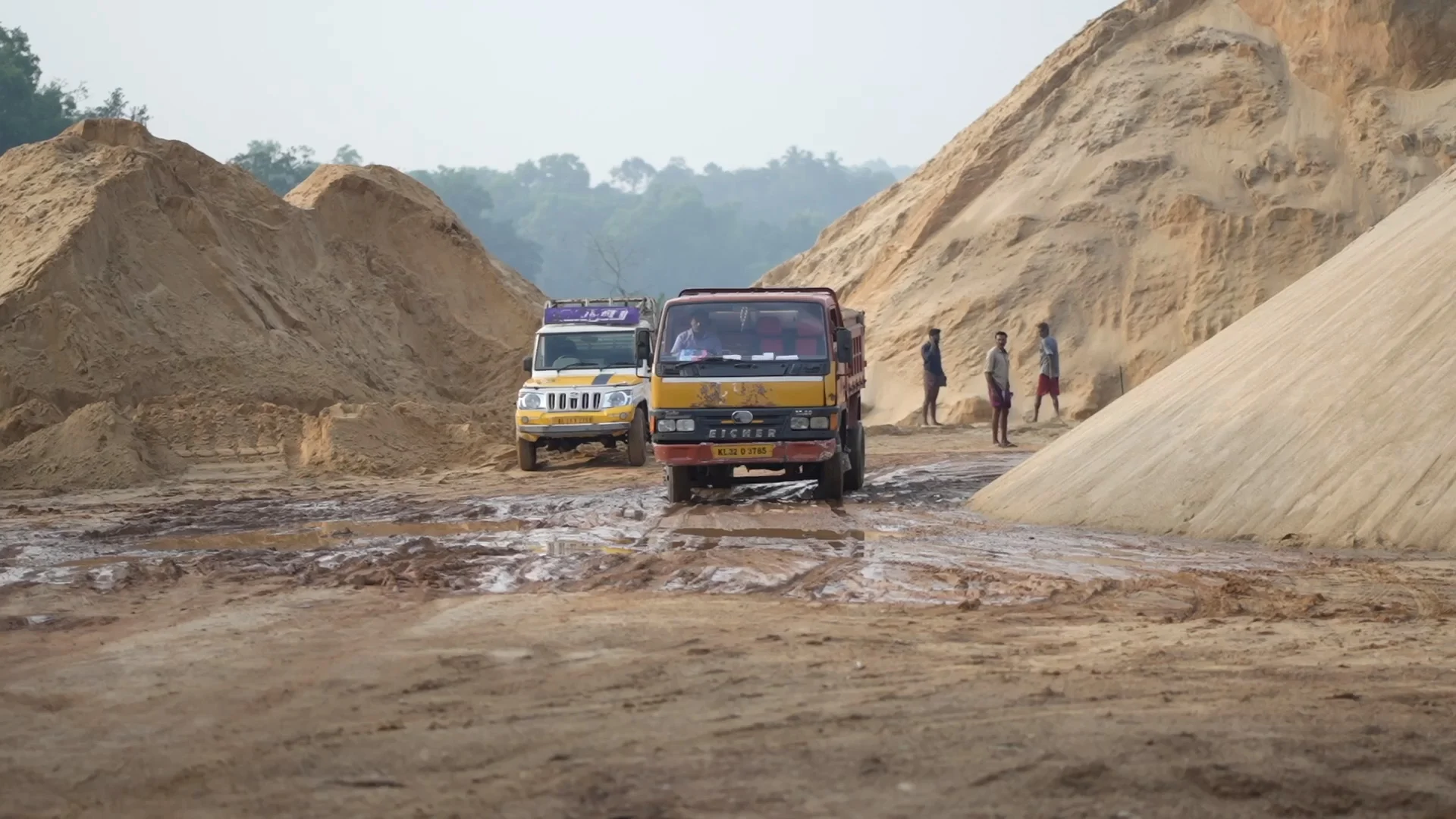
Quality Assurance
Assured quality in each load of sand
Certification Process
How We Test and
Certify Every Batch
01
Source Extraction
Sand is hydraulically dredged from approved dam reservoir zones under valid Kerala state mining licences. Every extraction point is geo-referenced and documented for full source traceability.
02
Washing & Screening
Raw material passes through water-wash screens to remove silt, clay, organic matter, and oversized particles — producing consistently graded clean sand conforming to IS 383:2016 Zone II requirements.
03
pH Testing
Every batch is tested using standardised electrochemical pH measurement before dispatch. Only material between pH 6.8 and 7.2 is cleared. Batches outside this range are rejected. No exceptions.
04
Documentation & Delivery
Cleared sand is dispatched with three documents: source licence, pH test certificate, and delivery challan. These travel with every truck — giving you verifiable proof of quality at the point of delivery.
Documentation
Three Documents With
Every Delivery
Quality without documentation is just a claim. Every Stonage delivery comes with three verifiable documents that prove exactly what you are building with — suitable for RERA projects, government contracts, institutional construction, and private homeowners.
Source Licence
Issued by the Kerala State Mining and Geology Department, this document confirms that the sand in your delivery was legally extracted from a licensed dam reservoir zone. It records the extraction location, licence number, and authorisation details — making your supply fully compliant with Kerala mining regulations.
Required for: Government tenders · RERA compliance · Legal sourcing verification
pH Test Certificate
Issued per batch following standardised electrochemical pH testing. Confirms the specific pH reading of your delivery falls between 6.8 and 7.2. Includes batch reference, test date, method, and result. No batch without a passing certificate is dispatched from our yard.
Required for: Structural engineers · Quality audits · RERA documentation · Institutional projects
Delivery Challan
Records the quantity supplied, source reference, vehicle details, delivery address, and date. Cross-referenced with the source licence and pH certificate. Provides complete chain-of-custody documentation from dam source to your construction site.
Required for: Site records · Quantity verification · Audit trails · Property documentation
Technical Questions
Sand Quality
Questions Answered
Stonage dam-dredged river sand has a certified pH between 6.8 and 7.2 — classified as neutral. This matters because pH determines how sand interacts with cement and steel. Alkaline sand (pH above 8, typical of M-Sand) triggers alkali-silica reactions that weaken concrete over time. Acidic sand corrodes steel reinforcement. Neutral sand from Stonage eliminates both risks. Every batch is tested and certified before dispatch.
Stonage dam-dredged river sand has a silt content below 3% — well within the IS 383:2016 permissible limit of 15% for plastering sand and 3% for concrete sand. Decades of natural hydraulic settling in dam reservoirs separates fine silt from usable sand particles. Our washing and screening process further reduces silt before dispatch.
Yes. Stonage dam-dredged river sand falls within Zone II gradation as per IS 383:2016 — the Bureau of Indian Standards specification for fine aggregates used in concrete. Zone II is the most versatile gradation, suitable for both concrete and masonry mortar. The fineness modulus is typically 2.3–3.1 and specific gravity 2.60–2.65 — consistent with high-quality natural river sand.
Rounded particles, shaped naturally by water erosion, reduce internal friction in a mix — meaning less water is needed to achieve workability. This directly lowers the water-cement ratio, which improves compressive strength. Angular particles (typical of M-Sand) interlock and resist flow, requiring more water and cement to achieve the same workability — increasing both cost and the risk of shrinkage cracking.
Salt and chlorides in sand cause two serious long-term problems. First, efflorescence — soluble salts migrate to the plaster surface as it dries, creating white staining that returns even after painting. Second, rebar corrosion — chlorides penetrate concrete and destroy the passive oxide layer on steel reinforcement, causing it to rust and expand, cracking the concrete from inside. Stonage dam sand has negligible salt content — eliminating both risks entirely.
Every Stonage delivery includes three documents: a Source Licence from the Kerala State Mining and Geology Department confirming legal extraction, a pH Test Certificate confirming the batch pH is between 6.8 and 7.2, and a Delivery Challan recording quantity and source details. These documents meet requirements for RERA-registered projects, government contracts, and institutional construction across Kerala.